


Hi friends, welcome back to my Newport, Rhode Island series! On our second full day we had another leisurely morning and grabbed coffee from Drift Café. We picked up our car and drove about ten minutes to The Breakers mansion for our first tour of the famous Gilded Age mansions. You can purchase tickets for one house, three, or five. If you plan on seeing more than three, I recommend you purchase a one-year membership to the Preservation Society which is about $30 cheaper than the five houses, plus it’s tax deductible! The Preservation Society created a free app that has a guided tour of each of the main houses so I also recommend bringing headphones and downloading the app ahead of time so you can get the most from the homes. The tours were great and I’ve summarized a lot of facts from the them in these next few posts.


At 138,300 square feet, The Breakers is the largest house in the collection and was commissioned by Cornelius Vanderbilt II in 1893 after the previous house burned down. He was the grandson of Cornelius Vanderbilt and succeeded his father, William Henry Vanderbilt as chairman and president at New York Central Railroad, the family empire. When Cornelius II died in 1899, it’s estimated he was worth the equivalent of $2.3 billion dollars.


This waterfront mansion sits on 13 acres and has 70 rooms, of which 48 are bedrooms. It was designed based on the Italian Renaissance Villas and took two years to build. It also has electricity and gas lighting throughout, a luxury for the time.


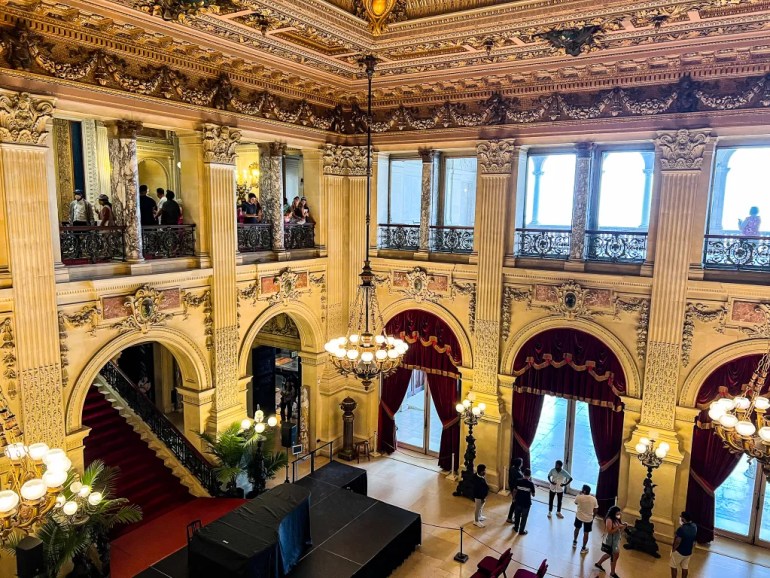
This 50-foot-tall grand entrance was very polarizing, people either felt it was vulgar or thought it was stunning. (It was set up for an event while we were there)


The staircase design was inspired by the Opera House in Paris and clearly wowed guests.


The dining room is adorned with Baccarat crystal chandeliers and wall sconces. Like the foyer, this room has a 50-foot-tall ceiling and was used to entertain the elite Newport residents. No detail was overlooked and it reminded me of some of the rooms in Versailles.


The chandelier in the billiard room is made of wrought iron and bronze making it so heavy they had to attach it to a structural beam. The floor is made of little pieces of marble that were hand set, and the walls are marble slabs imported from Switzerland. The acorns throughout the décor and floor were a symbol of the Vanderbilt family and represent strength and long life. This room might look familiar to you if you’ve watched “The Gilded Age” on HBO, they filmed a scene here and used the actual billiard table but with a felt covering to protect the table. We haven’t watched it yet, but it’s on our list.


The Morning Room’s wall panels are made from platinum, one of the most expensive metals in the world.


The Music Room hosted debutante balls and Cornelius II’s daughter Gertrude’s wedding. It’s hard to believe but this room was designed in a workshop in France, taken apart, and then shipped to Newport.

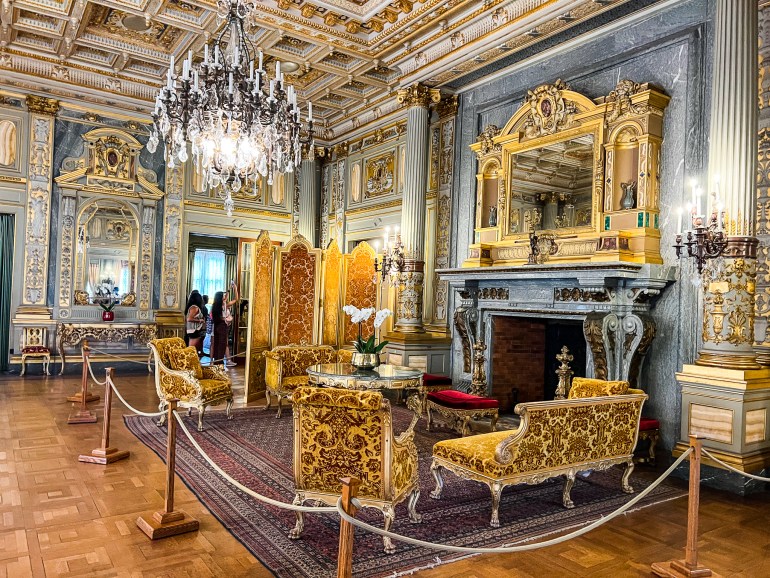
This stately Library was designed around a 500-year-old fireplace imported from a French Chateau.

We then headed upstairs and admired the view from the balcony. It’s hard to comprehend having all this luxury for just a summer home they only spent about eight weeks at a year.


Cornelius Vanderbilt’s bedroom.

This bathtub was carved from one slab of marble and designed based on a Roman coffin. It is so thick it had to be filled and drained a few times before it was warm enough to bathe in.

Mrs. Vanderbilt’s bedroom and office. It was a tough job running a house this size and hosting lavish parties.


This room belonged to Gertrude, the Vanderbilt’s oldest daughter. She married Harry Payne Whitney, became a sculptor, and founded the Whitney Museum of American Art in NYC. I have yet to visit, but it’s on my list.

It was an overcast day, but the views from the Upper Loggia sure were beautiful!

Upstairs are two more floors with 33 servant bedrooms.

The Grand Staircase was designed with stairs two inches shorter than normal so ladies in their big dresses could make their debut easier. The bottom of the stairs features a picture of Mrs. Vanderbilt. The left is a picture of Cornelius Vanderbilt the First.

A kitchen large enough to feed all the important guests. The kitchen is in a sperate area of the house to prevent any fires destroying the rest of the house again.


The butler’s pantry. You had to take a dumbwaiter to get up to the second level and all the silver was locked up in a safe each night. This is the last official room of the tour and we exited through the gift shop, but not before picking out an ornament (the membership gets you 10% off in the gift shop, it’s a gift that keeps on giving).

Last stop here was the massive backyard that hosted many epic parties.


Countess Széchenyi, youngest daughter of Cornelius II, inherited the house and in 1948 she allowed the Preservation Society of Newport County to give tours of the bottom floor in exchange for covering the operating expenses. The Preservation Society officially purchased the house in 1972, and it became a National Historic Landmark in 1994. As part of the purchase agreement, Countess Széchenyi lived in the house until she died in 1998 and her heirs lived here until 2018. The Preservation society planned to build a modern welcome center/ticket area in front of the house that the family strongly opposed. A fight about it went all the way to the Supreme Court, but the Preservation society ultimately won out and the city approved zoning for it. The Preservation society said the family had to leave the third floor living quarters because the plumbing and electrical weren’t fit for living and were a risk to the preservation of the house, but some think it was payback for them not being on board with the new addition. The Gilded Age may be over, but the drama certainly isn’t! I hope you enjoyed this tour of The Breakers! We loved touring, even though this house is definitely not in our tastes. I always enjoy seeing how the upper class lived and all the opulence they were accustomed to. I have lots more coming so stay tuned 🙂
Posts in this series: